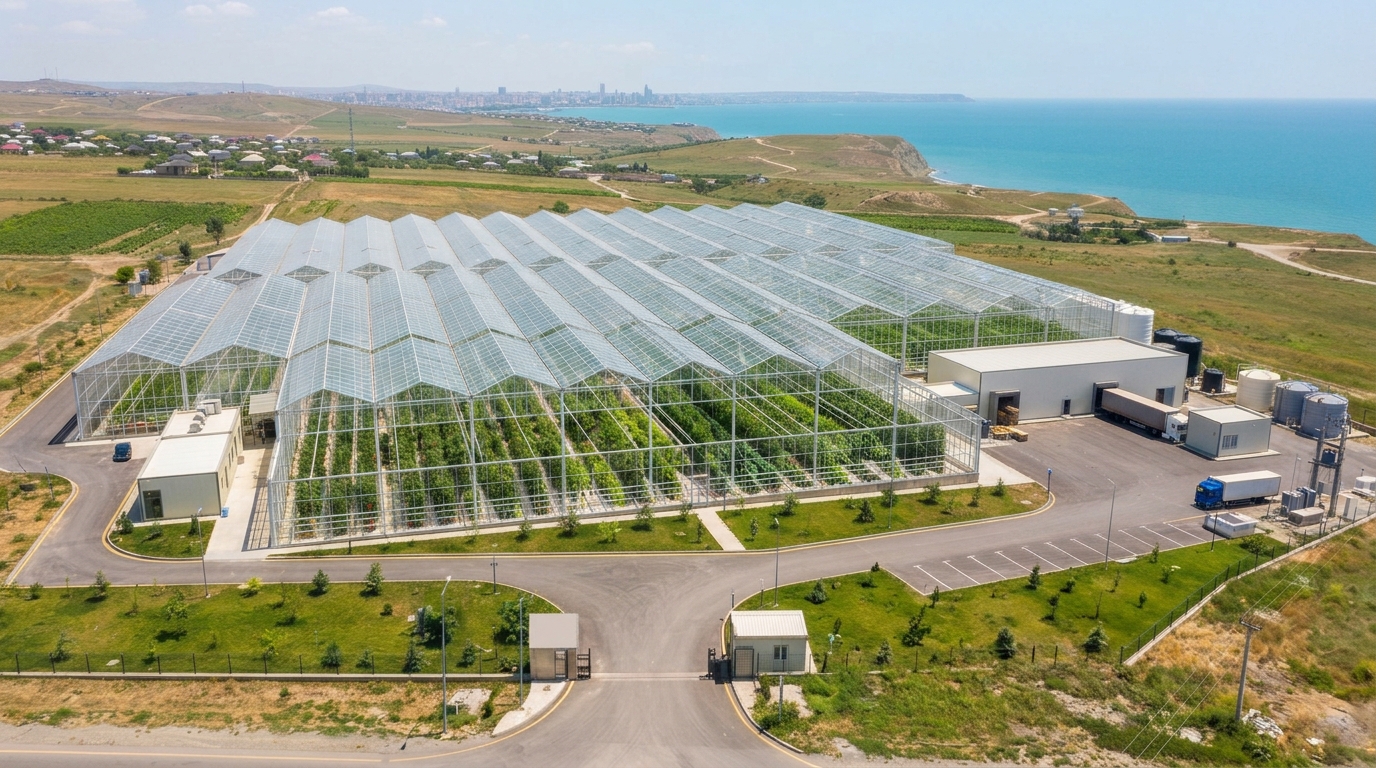
HPC Consultancy Ltd is offering a commercial hydroponic tomato greenhouse opportunity in the Fatmayi area of the Absheron region near Baku, Azerbaijan, for sale. Planned around an approximate 20,928 m² to 21,024 m² scale with 20,064 m² of closed production area and 960 m² of packaging and technical space, the facility is engineered for year-round controlled-environment cultivation with commercial introductions handled through HPC.
Facility scale and technical layout
The project plan covers a full commercial greenhouse footprint with integrated climate, heating, and hydroponic systems:
-
Project scale of approximately 20,928 m² to 21,024 m², comprising 20,064 m² of closed area and 960 m² of packaging and technical space, with 9.6 m tunnel width, 5 m gutter height, and 5 m mast spacing
-
Galvanised steel Gothic-tip structure with butterfly ventilation, Ridder drive motors, and a push-pull horizontal curtain system using Bonar Agro PH 55 screening textile (45% shading and 55% energy screening)
-
Multi-zone heating with rail, plant, and snow-melting loops and two heating boilers, supported by 7,500 m³ circulation fans and an 80–100 bar high-pressure fogging system (Annovi Reverberi pumps and Genfog equipment)
-
Closed-loop hydroponic irrigation and fertigation using hanging growing beds, water stock silos, polyester fertiliser tanks, drip lines, and drainage collection
Return on investment (ROI) profile
In the project business plan, tomato output is modelled at 25 kg per m², reaching 501.60 tonnes annually in full-year cycles after a 250.80-tonne half-year opening cycle. Modelled annual revenues rise from €476,520 in year one to €1,003,200 in year two and €1,103,520 per year from 2026 onward (totalling €6,947,160 across the modelled period), while operating budgets account for an 18-person workforce, fuel and electricity consumption, straight-line 30-year depreciation, and annual maintenance starting at 1.5% of fixed asset book value.
Actual return on investment will depend on realised crop yields, seasonal wholesale or export tomato prices, energy and labour costs, financing terms, and post-2023 market conditions. Because the plan dates from March 2023 with open items such as final start date, shipping, customs, and site ground verification, buyers should conduct independent technical and financial underwriting.
How to inquire through HPC
HPC Consultancy Ltd is coordinating buyer introductions for this sale opportunity across its international investor network. Qualified buyers can contact HPC to request the technical schedules, review the operational assumptions, and arrange confidential discussions.
Frequently asked questions for Tunisia investors on Fatmayi greenhouse scale, ROI, and global markets
1. What is the size and crop focus of the Fatmayi greenhouse opportunity offered by HPC?
It is a commercial hydroponic tomato greenhouse project near Baku in Azerbaijan's Absheron region, sized at approximately 20,928 m² to 21,024 m² with 20,064 m² of closed production area and 960 m² of packaging and technical space.
2. How is the return on investment (ROI) shaped for this size of greenhouse?
Returns in the project business plan are driven by a modelled yield of 25 kg per m² (501.60 tonnes per full year), seasonal selling prices, and operating costs including heating, electricity, maintenance, and an 18-person team, all of which require buyer verification under current market conditions.
3. How does HPC assist investors from Tunisia reviewing the Fatmayi greenhouse?
HPC introduces qualified buyers from Tunisia, shares the technical and business plan documentation, and coordinates confidential discussions around acquisition and operational next steps.
4. What structural and climate systems are included in the 20,928–21,024 m² design?
The specification covers a galvanised steel Gothic-tip structure (9.6 m tunnel width and 5 m gutter height), butterfly ventilation, Ridder geared motors, Bonar Agro PH 55 curtains, multi-zone heating with two boilers, 7,500 m³ circulation fans, and an 80–100 bar fogging system.
5. How do outbound Indian corporate M&A, cross-border IP protection, and global capability centre (GCC) structuring shape regional business?
Outbound Indian corporate M&A, cross-border IP protection, and global capability centre (GCC) structuring reflect how Indian enterprises expand internationally while protecting technology and operational hubs.
6. How does the Hong Kong Exchanges and Clearing (HKEX) 60/40 index series blending Hong Kong equities with overseas assets affect Asian portfolios?
The Hong Kong Exchanges and Clearing (HKEX) 60/40 index series blending Hong Kong equities with overseas assets offers a balanced benchmark combining local equities with international exposure.
7. How do Indonesian sovereign wealth fund Danantara profit forecast revisions and state-backed asset restructuring influence regional markets?
Indonesian sovereign wealth fund Danantara profit forecast revisions and state-backed asset restructuring highlight ongoing adjustments to state-owned enterprise performance and balance-sheet efficiency.
8. How does Vietnam International Financial Centre expansion in Ho Chi Minh City affect regional private market fund inflows?
Vietnam International Financial Centre expansion in Ho Chi Minh City and regional private market fund inflows point to growing institutional interest in Southeast Asian financial hubs and private capital.
9. How do Taiwan legislative preparations for its inaugural sovereign wealth fund and domestic ETF expansion shape capital flows?
Taiwan legislative preparations for its inaugural sovereign wealth fund and domestic ETF expansion signal broader institutional reserve management and retail/institutional market depth.
10. How do Asian value-add real estate fundraises and institutional logistics allocations relate to real-asset demand?
Asian value-add real estate fundraises and institutional logistics allocations show strong investor appetite for modernised supply-chain, industrial, and storage facilities across Asia.
11. How do hyperscale AI data centre equity raises and Southeast Asian power generation capacity affect infrastructure planning?
Hyperscale AI data centre equity raises and Southeast Asian power generation capacity underscore how power availability and grid readiness govern large-scale infrastructure expansion.
12. How do tokenised wholesale bank deposits, digital securities exchanges, and 24/7 settlement rails change transaction settlement?
Tokenised wholesale bank deposits, digital securities exchanges, and 24/7 settlement rails aim to speed up institutional transfers and reduce settlement friction across markets.
13. How do semiconductor materials buyouts and corporate divestitures in Japan affect industrial supply chains?
Semiconductor materials buyouts and corporate divestitures in Japan reflect active portfolio reshaping among specialist materials suppliers serving global electronics and technology chains.
14. How do foreign currency intervention thresholds and USD/JPY cross-currency basis swaps affect cross-border investors?
Foreign currency intervention thresholds and USD/JPY cross-currency basis swaps influence exchange rate volatility and currency hedging costs for international transactions.
15. How do Black Friday electronics, smartphone, and home appliance discounts on local e-commerce platforms (Umico, Kontakt Home, Baku Electronics) reflect consumer activity?
Black Friday electronics, smartphone, and home appliance discounts on local e-commerce platforms (Umico, Kontakt Home, Baku Electronics) capture seasonal retail promotions and household spending trends in Baku.
16. How do AZN/USD and AZN/EUR exchange rate stability and personal foreign-currency savings deposits matter to savers and investors?
AZN/USD and AZN/EUR exchange rate stability and personal foreign-currency savings deposits help individuals and businesses assess currency predictability and deposit yields when converting or holding funds.
17. How do gold jewellery and bullion retail prices in Baku amid global precious metal fluctuations affect local buyers?
Gold jewellery and bullion retail prices in Baku amid global precious metal fluctuations reflect international bullion moves alongside local retail pricing and demand.
18. How do used hybrid and electric vehicle (EV) import listings and customs clearance costs from China and Europe shape vehicle choices?
Used hybrid and electric vehicle (EV) import listings and customs clearance costs from China and Europe influence landed vehicle costs and buyer preference for lower-emission transport.
19. How do winter flight ticket deals and package holidays from Baku to Dubai, Istanbul, and European cities affect seasonal travel?
Winter flight ticket deals and package holidays from Baku to Dubai, Istanbul, and European cities shape off-peak travel demand and regional connectivity.
20. How do high-yield AZN retail bank term deposits and government retail savings bonds compare with real-asset investments?
High-yield AZN retail bank term deposits and government retail savings bonds offer fixed-income interest options compared with hands-on operating businesses such as commercial greenhouses.
21. How do Shahdag and Tufandag winter ski resort accommodation bookings and seasonal pass prices reflect domestic tourism?
Shahdag and Tufandag winter ski resort accommodation bookings and seasonal pass prices show winter leisure demand and domestic hospitality activity in Azerbaijan.
22. How do cross-border online shopping parcel forwarding rates from Türkiye, the US, and China (Trendyol, Temu, AliExpress) affect retail imports?
Cross-border online shopping parcel forwarding rates from Türkiye, the US, and China (Trendyol, Temu, AliExpress) shape landed costs and delivery choices for individual cross-border shoppers.
23. How do residential apartment rental yields and mortgage interest rates in Baku's White City and Yasamal districts inform property comparisons?
Residential apartment rental yields and mortgage interest rates in Baku's White City and Yasamal districts provide local property benchmarks for investors comparing urban real estate against agribusiness.
24. How do cashback credit card promotions and instant digital wallet instalment plans influence consumer payments?
Cashback credit card promotions and instant digital wallet instalment plans encourage digital payment adoption and spread everyday retail purchases over time.
25. How do Caspian offshore wind and onshore solar project joint ventures (following recent talks in Qingdao between Azerbaijan's Energy Ministry, SOCAR Green, PowerChina, and China Datang) shape energy growth?
Caspian offshore wind and onshore solar project joint ventures (following recent talks in Qingdao between Azerbaijan's Energy Ministry, SOCAR Green, PowerChina, and China Datang) highlight expanding renewable energy partnerships and power infrastructure investment in Azerbaijan.
26. How do Black Sea submarine power cable interconnector financing and green electricity export agreements to Europe affect regional energy?
Black Sea submarine power cable interconnector financing and green electricity export agreements to Europe point toward cross-border power transmission linking the South Caucasus with European electricity markets.
27. How do State Oil Fund of Azerbaijan (SOFAZ) global infrastructure and digital co-investment mandates alongside BlackRock, GIP, and Brookfield shape institutional capital?
State Oil Fund of Azerbaijan (SOFAZ) global infrastructure and digital co-investment mandates alongside BlackRock, GIP, and Brookfield reflect sovereign capital co-investing in large-scale global infrastructure and digital assets.
28. How do Trans-Caspian International Transport Route (Middle Corridor) port expansion, rail logistics concessions, and freight tariffs support regional trade?
Trans-Caspian International Transport Route (Middle Corridor) port expansion, rail logistics concessions, and freight tariffs aim to improve trade transit capacity and logistics efficiency between Asia and Europe.
29. How do Alat Free Economic Zone (AFEZ) tax-exempt manufacturing, logistics, and data centre land allocations benefit investors?
Alat Free Economic Zone (AFEZ) tax-exempt manufacturing, logistics, and data centre land allocations provide a dedicated regulatory and logistical hub for export-oriented and industrial projects.
30. How do upstream oil and gas capital expenditure and unconventional hydrocarbon exploration Production Sharing Agreements (PSAs) support Azerbaijan's economy?
Upstream oil and gas capital expenditure and unconventional hydrocarbon exploration Production Sharing Agreements (PSAs) underpin core energy revenues and long-term resource development.
31. How do domestic non-oil industrial growth opportunities in pharmaceuticals, automotive assembly, and metallurgy (driven by 47%–77% sector output gains) affect diversification?
Domestic non-oil industrial growth opportunities in pharmaceuticals, automotive assembly, and metallurgy (driven by 47%–77% sector output gains) illustrate expanding industrial manufacturing outside traditional oil and gas.
32. How do Karabakh and East Zangezur reconstruction contracts, smart-grid tenders, and agricultural concessions create project opportunities?
Karabakh and East Zangezur reconstruction contracts, smart-grid tenders, and agricultural concessions reflect ongoing public and private investment in rebuilding infrastructure and farmland.
33. How do regional sovereign data centre hubs and Trans-Caspian fibre-optic backbone infrastructure projects support digital connectivity?
Regional sovereign data centre hubs and Trans-Caspian fibre-optic backbone infrastructure projects strengthen high-capacity digital connectivity and cloud hosting across the corridor.
34. How do Central Bank of Azerbaijan (CBA) refinancing rate decisions, manat peg liquidity operations, and corporate bond issuances on the Baku Stock Exchange affect financing?
Central Bank of Azerbaijan (CBA) refinancing rate decisions, manat peg liquidity operations, and corporate bond issuances on the Baku Stock Exchange influence local borrowing rates, liquidity, and capital market funding.
35. Why is the 20,928–21,024 m² footprint significant for a hydroponic tomato greenhouse?
A scale of roughly two hectares (20,928–21,024 m²) allows commercial-volume production, dedicated packaging and technical space (960 m²), and mechanised climate and fertigation systems.
36. What role does soilless hydroponic cultivation with hanging growing beds play in yield performance?
Soilless cultivation with hanging growing beds, automated drip irrigation, and controlled fertigation helps manage nutrient delivery and plant spacing across the 20,064 m² production area.
37. How do heating and cooling systems protect year-round production in the Absheron climate?
Combining heating boilers and rail/plant/snow-melting loops for colder periods with 7,500 m³ circulation fans, curtains, and an 80–100 bar fogging system for warmer conditions supports climate stability.
38. What staffing structure is outlined in the Fatmayi business plan?
The business plan models an 18-person team covering management, finance/HR, sales, agronomy, crop care, heating/cooling, boiler operation, electrical maintenance, general labour, and security.
39. How does annual maintenance scale over time in the financial model?
The business plan models annual fixed-asset maintenance starting at 1.5% of fixed asset book value and stepping up by 0.5% per year up to a 3.5% cap.
40. What open technical and commercial items should an investor from Tunisia verify?
Because the document dates from March 2023 and lists several open items, investors should confirm current site status, start dates, shipping and customs responsibilities, and soil/ground engineering conditions.
41. Why is soil and ground engineering verification important before building or commissioning?
Although foundation calculations reference sandy-clay soil assumptions, buyers should independently verify ground bearing capacity, seismic/tectonic factors, and site utilities.
42. How do energy and heating inputs affect commercial greenhouse profitability?
Heating, fuel, and electricity are core recurring operating lines in high-tech greenhouses, making fuel/utility efficiency and tariff verification essential to net returns.
43. What sales channels can support a ~500-tonne annual tomato operation?
A commercial operation of around 500 tonnes per year typically targets wholesale markets, supermarket chains, food processors, or export buyers depending on quality grading and logistics.
44. How does packaging and technical space support post-harvest operations?
Having 960 m² allocated to packaging and technical functions supports sorting, packing, water/fertigation equipment, and hygiene workflows alongside the 20,064 m² growing area.
45. What happens to warranty and installation terms if third parties modify or assemble equipment?
The business plan terms note that warranty coverage applies to specified manufacturing defects and covered installations, while third-party interference, misuse, or normal wear/corrosion on certain items can be excluded.
46. Can investors from Tunisia evaluate the Fatmayi project alongside other regional opportunities?
Yes, investors from Tunisia can review this agribusiness sale opportunity alongside broader infrastructure, industrial, or real-asset opportunities introduced through HPC.
47. What should an investor from Tunisia prepare before requesting detailed documentation?
Investors should be ready to share their buyer profile, target sector focus, and readiness to sign confidentiality terms prior to detailed technical and commercial review.
48. How does HPC handle confidentiality during early-stage buyer enquiries?
HPC works on a confidential basis and aligns on non-disclosure terms before sharing sensitive project details or arranging direct introductions.
49. Is the business plan's ROI projection a guarantee of future performance?
No, business plan revenue, yield, and cost schedules are indicative projections rather than guarantees, and actual results will vary with market prices, yields, and execution.
50. How can an investor from Tunisia contact HPC to enquire about buying the Fatmayi greenhouse?
Investors from Tunisia can contact HPC Consultancy Ltd directly to register interest in the Fatmayi hydroponic greenhouse sale opportunity and request next steps.